 Data & metrics
Power Zones — Why Coggan's Classic Model Isn't Always Optimal
Coggan's 6-7 zones from FTP work for most riders, but not everyone. Where rigid percentage boundaries diverge from your physiology, and what to do about it.
 Data & metrics
Heart Rate vs. Power — Why Beats Per Minute Alone Aren't Enough in Modern Training
Heart rate lags effort by 30–90 s and drifts with heat or caffeine. Power measures work instantly. When to use which?
 Data & metrics
Why You Need a Power Meter and How to Choose One
Heart rate tells you how your body reacts, with a lag. Power tells you exactly what you're doing, in watts, right now. Here's how to pick your first one.
 Data & metrics
Is W/kg the Only Metric That Matters in Cycling?
W/kg rules on climbs, but on the flat absolute watts and aerodynamics decide, and in races — repeatability. When to look at what?
 Data & metrics
How to Climb Hills Faster on a Bike — Technique and Cadence
Climbs are the moment of truth on a bike. "Faster uphill" doesn't mean "push harder" — the key is pacing, cadence and position, not pure brute force.
 Data & metrics
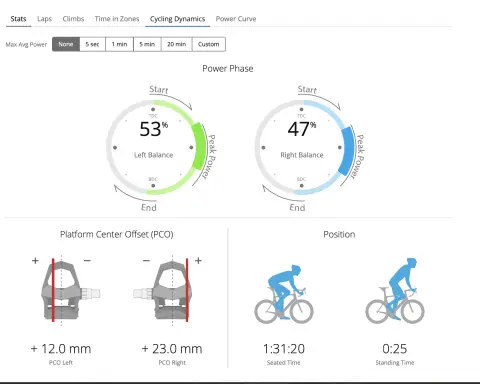
Cycling Dynamics from Power Pedals — How to Read the Data
L/R balance, Power Phase, and Platform Center Offset explained with real Favero Assioma Pro MX data from a Garmin Edge 840 and Garmin Connect.
 Data & metrics
TSB — How to Know From Your Data You're Ready to Race
"I feel good" isn't enough to know if you've hit peak form for race day. TSB gives a concrete, numerical answer — if you know what value to target.
 Data & metrics
Cycling Cadence — What It Is and What's Optimal
Cadence is how many times your crank turns per minute. "Spin faster" vs "push harder" is cycling's oldest debate — the truth is more nuanced.
 Data & metrics
Amateur Training Burnout — How to Spot It in Your TSS
One bad training day is nothing. Burnout doesn't show up in a single session, but in the shape of your TSS chart over weeks. How to read the pattern.
 Data & metrics
A Used Power Meter — What to Check Before You Click "Buy Now"
A used power meter can cost half the price of a new one. But unlike a saddle or handlebars, you're buying electronics with a strain gauge. What to check.
 Data & metrics
Zwift Racing — How to Pace Yourself by Your Power Profile
On Zwift, nobody wins on willpower alone — data wins. Know your power curve before you start, and it changes your whole race tactic.
 Data & metrics
When to Back Off Training? What HRV, Resting Heart Rate and TSB Are Telling You
The plan says "threshold today", your body says otherwise. Three signals — HRV, resting heart rate and TSB — together give a clear enough answer.